Popularity Asset Pricing Model

Professor Roger Ibbotson is one of the most respected and influential researchers of the current era. His book “Stocks, Bonds, Bills, and Inflation” is a classic and often serves as a reference for information about capital market returns. Therefore we always pay attention to his publications. His actual work, “Popularity – A Bridge between Classical and Behavioral Finance”, which is written with Thomas M. Idzorek, Paul D. Kaplan, and James X. Xiong, is now available on SSRN.

In their work, authors explain the term “Popularity” from an asset pricing point and show how “Popularity” can be a broad umbrella under which nearly all market premiums and anomalies (including the traditional value and small-cap) can fall. They develop a formal asset pricing model that incorporates the central idea of “Popularity”, which they call the “popularity asset pricing model” (PAPM). Based on this model, they predict characteristics as a company’s brand, reputation, and perceived competitive advantage to be new equity factors.

It’s a long read, but we at Quantpedia really recommended it for all equity portfolio managers …

Authors: Ibbotson, Idzorek, Kaplan, Xiong

Title: Popularity: A Bridge between Classical and Behavioral Finance

Continue reading »

Three Methods to Fix Momentum Crashes

Everyone who lived during the 2007 and 2009 crisis knows what the biggest weakness of the equity momentum strategy was. It was right during the spring of 2009 when the financial markets were on its inflection point when the momentum strategy crashed. Right after that inflection point, stocks which were the biggest losers during the previous year performed exceptionally well and caused strong under-performance of classical long-short momentum strategy. How can we prevent this situation from happening again? That’s the topic of our favorite new recent study written by Matthias Hanauer and Steffen Windmueller. They analyze three momentum risk management techniques – idiosyncratic momentum, constant volatility-scaling, and dynamic scaling, to find the remedy for momentum crashes. It’s our recommended read for this week for equity long-short managers …

Authors: Matthias Hanauer and Steffen Windmueller

Title: Enhanced Momentum Strategies

Continue reading »

Commodity Futures Risk Premium – Historical Analysis

We at Quantpedia absolutely love long-term studies, and academic research paper written by Bhardwaj, Janardanan, and Rouwenhorst is really exceptional. There are a lot of studies covering a long history of equity and bond markets. But futures markets are not covered so well, and that’s the reason why is this paper so valuable. An additional plus is that study covers also delisted contracts, which makes the study’s data quality even better. Quantpedia’s recommended read to anyone interested in asset allocation into commodities …

Authors: Bhardwaj, Janardanan and Rouwenhorst

Title: The Commodity Futures Risk Premium: 1871–2018

Continue reading »

Momentum Explains a Bunch Of Equity Factors

Financial academics have described so many equity factors that the whole universe of them is sometimes called “factor zoo”. Therefore, it is no surprise that there is a quest within an academic community to bring some order into this chaos. An interesting research paper written by Favilukis and Zhang suggests explaining a lot of equity factors with momentum anomaly. They show that very often, up to 50% of the equity factor returns can be linked to returns of momentum strategy. This link is especially prevalent in short legs of equity factors.

Authors: Favilukis, Zhang

Title: One Anomaly to Explain Them All

Continue reading »

Commodity Futures Predict Stock Market Returns

Commodities are an essential exporting asset for a lot of countries around the world. Therefore, it is not surprising that the stock market returns of some emerging market countries are dependent on the returns of those commodities. What is more striking is that commodities do not forecast equity returns for only those few small exporting countries. Academic research paper written by Alves & Szymanowska shows that commodity futures returns predict stock market returns in 65 out of 70 countries and macroeconomic fundamentals in 62 countries. That is looking like an idea worth dig into …

Authors: Alves, Szymanowska

Title: The Information Content of Commodity Futures Markets

Continue reading »

What Affects the Correlation Between Stocks and Bonds

The correlation between bonds and stocks is essential information for asset allocation decisions; therefore understanding its macro-economic drivers is very valuable for all investors. Stocks-bonds correlation isn’t stable, as we have experienced in the last 30 years, as the correlation, which was positive until the end of the 1990s, changed sign at the turn of the century. Research paper written by Marcello Pericoli sheds more light on this issue and shows that the correlation is primarily influenced by the uncertainty about inflation and real interest rates as well as by co-movement between inflation, real interest rates and dividend growth.

Author: Pericoli

Title: Macroeconomics Determinants of the Correlation Between Stocks and Bonds

Continue reading »

Media Attention and the Low Volatility Effect

The low volatility factor is a well-known example of a stock trading strategy that contradicts the classical CAPM model. A lot of researchers are trying to come up with an explanation for driving forces behind the volatility effect. One such popular explanation is the ‘attention-grabbing’ hypothesis – which suggests that low-volatility stocks are ‘boring’ and therefore require a premium relative to ‘glittering’ stocks that receive a lot of investor attention. Research paper written by Blitz, Huisman, Swinkels and van Vliet tests this theory and concludes that ‘attention-grabbing’ hypothesis can't be used to explain outperformance of low volatility stocks.

Related to: #7 – Low Volatility Factor Effect in Stocks

Authors: Blitz, Huisman, Swinkels, van Vliet

Title: Media Attention and the Volatility Effect

Continue reading »

Three New Insights from Academic Research Related to Equity Momentum Strategy

What are the main insights?

– The momentum spread (the difference of the formation-period recent 6-month returns between winners and losers) negatively predicts future momentum profit in the long-term (but not in the following month), the negative predictability is mainly driven by the old momentum spread (old momentum stocks are based on whether a stock has been identified as a momentum stock for more than three months)

– The momentum profits based on total stock returns can be decomposed into three components: a long-term average alpha component that reverses, a stock beta component that accounts for the dynamic market exposure (and momentum crash risk), and a residual return component that drives the momentum effect (and subsumes total-return momentum)

– The profitability and the optimal combination of ranking and holding periods of momentum strategies for a sample of Core and Peripheral European equity markets the profitability vary across markets

Continue reading »

Two Versions of CAPM

This week's analysis of selected financial research paper contains more text and no picture, but we still think it's worth reading …

Authors: Siddiqi

Title: CAPM: A Tale of Two Versions

Link: https://papers.ssrn.com/sol3/papers.cfm?abstract_id=3350280

Abstract:

Given that categorization is the core of cognition, we argue that investors do not view firms in isolation. Rather, they view them within a framework of categories that represent prior knowledge. This involves sorting a given firm into a category and using categorization-induced inferences to form earnings and discount-rate expectations. If earnings-aspect is categorization-relevant, then earnings estimates are refined, whereas discount-rates are confounded with the category-exemplar. The opposite happens when discount-rates are categorization relevant. Earnings-focused approach such as DCF, generally used by institutional investors, leads to a version of CAPM in which the relationship between average excess return and stock beta is flat (possibly negative). Value effect and size premium (controlling for quality) arise in this version. Discount-rate focused approach such as multiples or comparables valuation, typically used by individual investors, leads to a second version in which the relationship is strongly positive with growth stocks doing better. The two-version CAPM accounts for several recent empirical findings including fundamentally different intraday vs overnight behavior, as well as behavior on macroeconomic announcement days. Momentum is expected to be an overnight phenomenon, which is consistent with empirical findings. We argue that, perhaps, our best shot at observing classical CAPM in its full glory is a laboratory experiment with subjects who have difficulty categorizing (such as in autism spectrum disorders).

Notable quotations from the academic research paper:

"Consider the following two empirical observations:

Firstly, stock prices behave very differently with respect to their sensitivity to market risk (beta) at specific times. Typically, average excess return and beta relationship is flatter than expected. It could even be negative. However, during specific times, this relationship is strongly positive, such as on days when macroeconomic announcements are made or during the night.

Secondly, a hue, which is halfway between yellow and orange, is seen as yellow on a banana and orange on a carrot. In this article, we argue that the two observations are driven by the same underlying mechanism.

The second observation is an example of the implications of categorization for color calibration. In this article, we argue that the first observation is also due to categorization, which gives rise to two versions of CAPM. In one version, the relationship between expected return and stock beta is flatter than expected or could even be negative, whereas in the second version, this relationship is strongly positive.

Categorization is the mental operation by which brain classifies objects and events. We do not experience the world as a series of unique events. Rather, we make sense of our experiences within a framework of categories that represent prior knowledge. That is, new information is only understood in the context of prior knowledge.

Here, in accord with cognitive science literature, we present a view of categorization that has both an upside as well as a downside, and apply this nuanced perspective to the capital asset pricing model (CAPM). If categorization is fundamental to how our brains make sense of information, then investor behavior, like any other domain of human behaviour, should also be viewed through this lens. This means that the traditional view that each firm is viewed in isolation needs to be altered. When an investor considers a firm, she views it within a framework of categories that represent prior knowledge. This involves sorting a given firm into a category based on attributes that are deemed categorization-relevant. Categorization-induced inferences help refine such attributes while confounding categorization-irrelevant attributes with the category-exemplar.

Valuation requires estimating earnings (cash-flows) potential and estimating discount-rates. Even among firms that sell similar products (same sector) some may have more similar earnings potential, whereas other may have more similar discount-rates. The former type may include firms with similar earnings-related fundamentals but very different levels of debt ratio and equity betas. Also, their multiples (generally related to inverse of the discount-rate) such as P/E, EV/Sales or EV/EBITDA could be very different. The latter type may include firms with similar debt ratios and equity betas or similar P/E and EV/EBITDA but quite different earnings or cash-flows fundamentals.

We argue that, an earnings-focused approach, such as discounted cash-flows (DCF), tends to categorize the former type of firms together, whereas, the relative valuation approach (RV) based on multiples such as P/E or EV/EBITDA tends to categorize the latter types of firms together. In other words, the choice of a valuation approach introduces a bias in how firms are categorized.

In this paper, we take discounted cash-flows (DCF) as the prototype of an earnings-potential focused approach, and valuation by multiples or relative valuation (RV) as the prototype discount-rate focused approach.

We show that when earnings aspect is categorization-relevant (as in DCF analysis), a version of CAPM is obtained, which displays a flatter or even negative relationship between stock beta and expected excess returns. Betting-against-beta anomaly is observed along with the value effect, as well as the size premium after controlling for quality (consistent with the findings in Asness et al 2018). We argue that this is the default version which typically prevails. While categorizing firms, if investors are focused on the discount rate aspect (as in RV analysis), then the discount-rates are refined whereas earnings estimates are confounded with the category-exemplar. A second version of CAPM arises. In this version, there is a strong positive relationship between beta and expected excess return.

One way to make sense of the co-existence of two versions is to classify investors as either earnings-focused or discount rate-focused. If earnings-focused investors dominate, then the first version is observed. If the discount-rate-focused investors dominate, then the second version is observed. Note, that earnings-focused approach (such as DCF) is typically employed by large institutional investors, whereas RV approach is associated with individual investors (and with sell-side equity analysts who publish research reports for individual investors).

If institutional investors are earnings-focused and individual investors are discount rate-focused, then the trading behavior of each type can be observed to make specific predictions:

1) Institutional investors typically avoid trading at the open and prefer to trade in the afternoon near the market close. The objective is to time the trade when the market is most liquid to avoid any adverse price impact. This means that trade at open is dominated by individual investors. So, one expects to see the relationship between stock beta and average return to be strongly positive (second version) overnight and flat or even negative (first version) intraday.

2) Institutional traders typically trade in the right direction prior to macroeconomic announcement days (suggesting superior information) with institutional trading volume falling sharply on macro-announcement days. As trade on such days is dominated by individual investors, one expects to see a strongly positive relationship (second version) on macro-announcement days.

3) The first version generally dominates intraday due to institutional investors being dominant. As the corresponding CAPM version comes with size and value effects, the prediction is that size and value are primarily intraday phenomena.

4) We show that, all else equal, discount rate-focused investors have higher willingness-to-pay than earnings-focused investors. If discount rate-focused investors dominate trade at open, whereas earnings-focused investors are active intraday, then one expects prices to typically rise overnight from close-to-open and fall intraday between open-to-close.

5) If momentum traders, who buy past winners and short past losers, are primarily individual investors, then one expects momentum to be an overnight phenomenon observed between close-to-open. This is because individual traders dominate trade at or near open.

"


Are you looking for more strategies to read about? Check http://\/\/new-fmhwbzh6ghd9hede.swedencentral-01.azurewebsites.net/Screener

Do you want to see performance of trading systems we described? Check http://\/\/new-fmhwbzh6ghd9hede.swedencentral-01.azurewebsites.net/Chart/Performance

Do you want to know more about us? Check http://\/\/new-fmhwbzh6ghd9hede.swedencentral-01.azurewebsites.net/Home/About


Follow us on:

Facebook: https://www.facebook.com/quantpedia/

Twitter: https://twitter.com/quantpedia

Youtube: https://www.youtube.com/channel/UC_YubnldxzNjLkIkEoL-FXg



Continue reading »

50 Years in PEAD (Post Earnings Announcement Drift) Research

A new research paper related to:

#33 – Post-Earnings Announcement Effect

Authors: Sojka

Title: 50 Years in PEAD Research

Link: https://papers.ssrn.com/sol3/papers.cfm?abstract_id=3281679

Abstract:

Analysing earning’s predictive power on stock returns was in the heart of academic research since late 60’s. First introduced to academic world in 1967 during seminar “Analysis of Security Prices” by Chicago University Professors Ray Ball and Philip Brown. In the next four decades was extensively analysed by many academics and is now a well-documented anomaly and is referred to as Post Earnings Announcement Drift (PEAD). This phenomenon is still at the centre of academic research because it stands at odds with efficient market hypothesis which assumes that all information is instantaneously reflected in stock prices. Professional investors are also closely looking at PEAD as it implies that it is easy to beat the market average by simply ranking stocks based on their earnings surprise and investing in the top decile, quintile or quartile and shorting the bottom part. Academic evidence shows that this strategy produces an abnormal return of somewhere between 2.6% and 9.37% per quarter, according to various authors. In this paper I will present existing evidence supporting and contradicting “PEAD”, the history of academic research in that field and various techniques used to verify the phenomenon. The paper is organised as follows: first the history of the PEAD academic research is presented, in the second more recent evidence and research techniques used by authors are presented and finally conclusions and various critics of PEAD are shown.

Notable quotations from the academic research paper:

"Post Earnings Announcement Drift is a measure of markets inability to price correctly information contained in earnings report. Since it was first spotted by Ball and Brown (1968), it went through rigorous academic scrutiny, first to test if it really exists (Ball (1978), Latane and Jones (1977)), then to measure its magnitude in various time frames, to offer explanations for its existence and find more PEAD variations. On average academics found that the postponed response to earnings information produces about 6% abnormal 60 days return (Dechow et al (2013)). The whole market reaction attributed to earnings report, measured from 60 days prior to earnings release to 60 days after is estimated at 18%, which means that about a third of the whole market response is delayed – Dechow et al (2013).

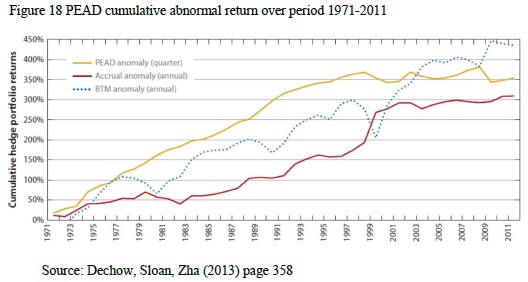
Figure 18 presents cumulative PEAD strategy abnormal returns for a 40-years period from 1971 to 2011. The total abnormal return of the strategy is an astonishing 350%, which is beat only by BTM (Book-to-Market) strategy. PEAD profits are very consistent up to late 90’s, then we can observe dips in the abnormal returns during internet bubble (1991-2001) and then during market recovery after 2008 crash. Since the middle of the 90’s PEAD returns became riskier and much lower than in the previous 25 years, it may be attributed to wider academic research in the field and wider recognition of the phenomenon among investors.

PEAD strategy chart

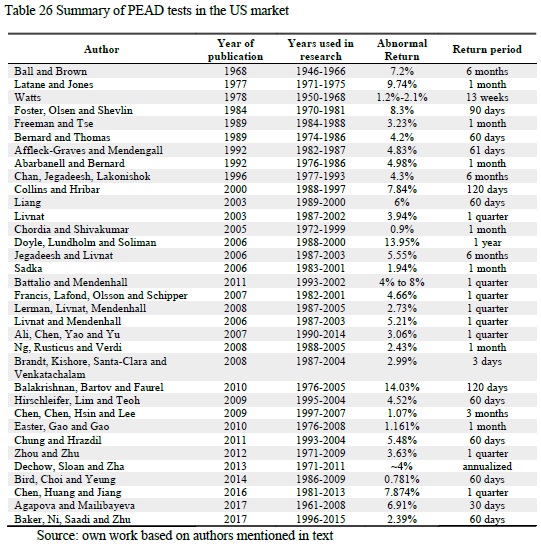
The PEAD strategy is not easy to implement in practice as it requires large scale data collection and data processing, more recent advancements in information processing technologies may also affect the magnitude of PEAD exploitation. A dominant part of research on PEAD was conducted in the US and based on US stock market data. The magnitude of PEAD computed by academics across time, since 1968 when first academic paper mentioning PEAD was published, up to the most recent evidence, are shown in Table 26.

Summary of PEAD tests

PEAD premium computed based on US market data by academics is not easily comparable. There are differences in period studied, subset of stocks used, definitions of expected earnings or unexpected earnings signal altogether. Among the results presented in Table 26, the highest return 14.03% in 120 days presented by Balakrishnan et al (2009) and the lowest is Chordia and Shivakumar (2005) 0.9% in 1 month. Both of those research papers confirm PEAD premium existence, but Chordia and Shivakumar (2005) focus their attention on explaining joint anomalies of momentum and PEAD, and form portfolios each month regardless of profit announcement date, taking last announced earnings in their SUE ranking, which obviously weakens the earnings signal."


Are you looking for more strategies to read about? Check http://\/\/new-fmhwbzh6ghd9hede.swedencentral-01.azurewebsites.net/Screener

Do you want to see performance of trading systems we described? Check http://\/\/new-fmhwbzh6ghd9hede.swedencentral-01.azurewebsites.net/Chart/Performance

Do you want to know more about us? Check http://\/\/new-fmhwbzh6ghd9hede.swedencentral-01.azurewebsites.net/Home/About


Follow us on:

Facebook: https://www.facebook.com/quantpedia/

Twitter: https://twitter.com/quantpedia

Youtube: https://www.youtube.com/channel/UC_YubnldxzNjLkIkEoL-FXg


Continue reading »
QuantPedia
Privacy Overview

This website uses cookies so that we can provide you with the best user experience possible. Cookie information is stored in your browser and performs functions such as recognising you when you return to our website and helping our team to understand which sections of the website you find most interesting and useful.