The Price of Transaction Costs

Capturing the systematic premia is the main aim of many quantitative traders. However, investors tend to overlook an important factor when backtesting. Trading costs are an essential part of every trade, and yet even when we consider them, we only use an approximation. The recent article from Angana Jacob (SigTech) looks into how heavily trading costs affect the overall return of various strategies and analyzes multiple ways of implementing trading costs into the trading rules themselves.

Continue reading »

What’s the Relation Between Grid Trading and Delta Hedging?

Delta hedging is a trading strategy that aims to reduce the directional risk of short option strategy and reach a so-called delta-neutral position. It does so by buying or selling small increments of the underlying asset. Similarly, grid trading is a trading strategy that buys/sells an asset depending on its price moves. When the price falls, it buys and sells when the price rises a certain amount above the buying price. This article examines the similarities between delta hedging and grid trading. Additionally, it analyzes numerous versions of grid trading strategies and compares their advantages and disadvantages.

Continue reading »

A Primer on Grid Trading Strategy

Grid trading is an automated currency trading strategy where an investor creates a so-called “price grid”. The basic idea of the strategy is to repeatedly buy at the pre-specified price and then wait for the price to rise above that level and then sell the position (and vice versa with shorting and covering). We will explore the basics and show favorable and unfavorable scenarios in the first article about this trading style. Later articles will dig deeper and investigate how Grid trading is related to other systematic trading strategies.

Continue reading »

Three Simple Tactical FX Hedging Strategies

There are many ways one can lose money when investing, and exchange rates are one of the potential risk factors. Luckily, there are several ways to minimize this type of loss in your portfolio. Systematic FX hedging that uses currency factor strategies is a way of protecting an existing or anticipated position from an unwanted move in an exchange rate. It does not eliminate the risk of loss completely but helps to manage currency exposure better.

Continue reading »

The Daily Volatility of Foreign Exchange Rates and The Time of Day

The foreign exchange market (FOREX) is opened 24 hours a day, but traders from different parts of the world tend to prefer different trading hours. However, various dominant trading sessions around the globe can lead to time-dependent market characteristics. Novel research by Doman and Doman (2020) has studied how does the daily volatility of FX rates depend on the time of day of calculation. The volatility changes through the day, and the underlying dynamics depend on the time of the estimate. The results can have important implication for practitioners since the volatility differences are large enough so they can influence trading/risk management decisions.

Authors: Małgorzata Doman and Ryszard Doman

Title: How Does the Daily Volatility of Foreign Exchange Rates Depend on the Time of Day at Which the Daily Returns Are Calculated?

Continue reading »

The Effectivity of Selected Crisis Hedge Strategies

During past months we made a set of articles analyzing the performance of equity factors and selected systematic strategies during coronavirus crisis. These articles were short-ranged with data only from the start of the year 2020, which is enough for the purpose of the quick blog posts, but very short-sighted to see the nature of these strategies. Therefore, we expanded the time range by 20 years. For a better understanding of hedge possibilities of these strategies, we have added a comparison to essential safe-haven assets, not only to equities.

Continue reading »

Transaction Costs Optimization for Currency Factor Strategies

A lot of backtests of systematic trading strategies omit transaction costs (in the form of spreads and fees). Simulation is then simpler, but resultant model portfolio and its performance can be misleading. In the case of currency factor investing, backtest without the costs simulation can pick currencies with wider spreads and higher volatilities. And in real trading, with real-world transaction costs, a strategy can, therefore, perform significantly worse than expected. A research paper written by Melvin, Pan, and Wikstrom offers an elegant optimization methodology to incorporate transaction costs into the backtesting process which allows strategies to retain their alpha …

Authors: Michael Melvin, Wenqiang Pan, Petra Wikstrom

Title: Retaining Alpha: The Effect of Trade Size and Rebalancing Frequency on FX Strategy Returns

Continue reading »

Alternative Fair-Value Models for Currency Value Strategy

The idea of buying an investment asset for a lower price than a fair-value is the cornerstone of value factor strategies. Various value strategies were popularized by famous investor Benjamin Graham (and his successors like Warren Buffett) and were firstly employed in the stock market. This idea of looking for investment opportunities that can be bought cheaply can also be applied in currency markets – Currency Value Factor strategy. There is, however, one catch – an investor must know the fair-value exchange rate for currencies. The most popular equilibrium exchange rate model used for this purpose is based on PPP (purchasing power parity). A new research paper written by Ca’ Zorzi, Cap, Mijakovic, and Rubaszek analyzes two additional models – Behavioral Equilibrium Exchange Rate (BEER) and the Macroeconomic Balance (MB) approach to assess which model has the best forecasting power.

Authors: Ca’ Zorzi, Cap, Mijakovic, Rubaszek

Title: The Predictive Power of Equilibrium Exchange Rate Models

Continue reading »

Demand and Supply of Safe Dollar Assets Move Markets

The United States has a special place in a global financial system. The U.S. dollar is the world’s reserve currency, and U.S. Treasuries are used as primary safe assets. Therefore, it is no surprise that the U.S. has some benefits from this arrangement. Academic research paper written by Krishnamurthy & Lustig shows that the U.S. derives a “convenience yield” from a demand of foreign investors. They consequently incur lower returns on their holdings of dollar-denominated safe assets. The FED’s conventional and unconventional monetary policy actions directly impact the supply of dollar-denominated safe assets. These decisions also affect the size of convenience yield, which causes moves in global financial markets…

Authors: Krishnamurthy, Lustig

Title: Mind the Gap in Sovereign Debt Markets: The U.S. Treasury basis and the Dollar Risk Factor

Continue reading »

Factor Investing in Currency Markets

A new research paper related to multiple currency strategies:

#5 – FX Carry Trade
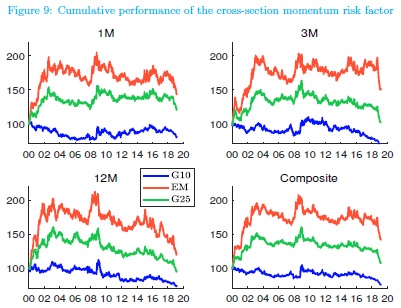
#8 – Currency Momentum Factor
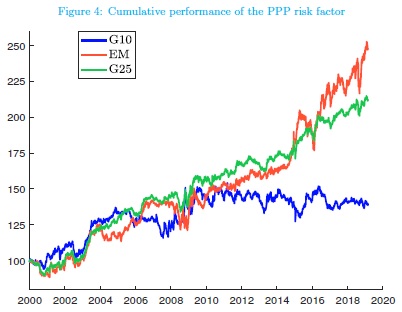
#9 – Currency Value Factor – PPP Strategy

Authors: Baku, Fortes, Herve, Lezmi, Malongo, Roncalli, Xu

Title: Factor Investing in Currency Markets: Does it Make Sense?

Link: https://papers.ssrn.com/sol3/papers.cfm?abstract_id=3415700

Abstract:

The concept of factor investing emerged at the end of the 2000s and has completely changed the landscape of equity investing. Today, institutional investors structure their strategic asset allocation around five risk factors: size, value, low beta, momentum and quality. This approach has been extended to multi-asset portfolios and is known as the alternative risk premia model. This framework recognizes that the construction of diversified portfolios cannot only be reduced to the allocation policy between asset classes, such as stocks and bonds. Indeed, diversification is multifaceted and must also consider alternative risk factors. More recently, factor investing has gained popularity in the fixed income universe, even though the use of risk factors is an old topic for modeling the yield curve and pricing interest rate contingent claims. Factor investing is now implemented for managing portfolios of corporate bonds or emerging bonds.

In this paper, we focus on currency markets. The dynamics of foreign exchange rates are generally explained by several theoretical economic models that are commonly presented as competing approaches. In our opinion, they are more complementary and they can be the backbone of a Fama-French-Carhart risk factor model for currencies. In particular, we show that these risk factors
may explain a significant part of time-series and cross-section returns in foreign exchange markets. Therefore, this result helps us to better understand the management of forex portfolios. To illustrate this point, we provide some applications concerning basket hedging, overlay management and the construction of alpha strategies.

Notable quotations from the academic research paper:

"In this paper, we propose analyzing foreign exchange rates using three main risk factors: carry, value and momentum. The choice of these market risk factors is driven by the economic models of foreign exchange rates. For instance, the carry risk factor is based on the uncovered interest rate parity, the value risk factor is derived from equilibrium models of the real exchange rate, and the momentum risk factor bene fits from the importance of technical analysis, trading behavior and overreaction/underreaction patterns. Moreover, analyzing an asset using these three dimensions helps to better characterize the fi nancial patterns that impact an asset: its income, its price and its trend dynamics. Indeed, carry is associated with the yield of the asset, value measures the fair price or the fundamental risk and momentum summarizes the recent price movements.
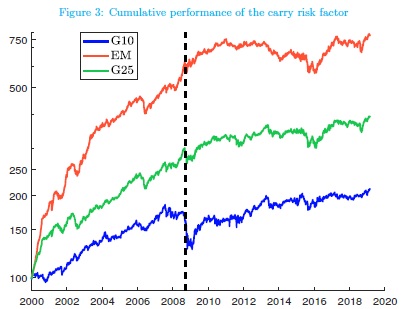
FX Carry

FX Value

FX Momentum

By using carry, value and momentum risk factors, we are equipped to study the cross-section and time-series of currency returns. In the case of stocks and bonds, academics present their results at the portfolio level because of the large universe of these asset classes. Since the number of currencies is limited, we can show the results at the security level.

For each currency, we can then estimate the sensitivity with respect to each risk factor, the importance of common risk factors, when speci fic risk does matter, etc. We can also connect statistical figures with monetary policies and regimes, illustrating the high interconnectedness of market risk factors and economic risk factors. The primary goal of building an APT model for currencies is to have a framework for analyzing and comparing the behavior of currency returns. This is the main objective of this paper, and a more appropriate title would have been "Factor Analysis of Currency Returns". By choosing the title "Factor Investing in Currency Markets", we emphasize that our risk factor framework can also help to manage currency portfolios as security analysis always comes before investment decisions.

This paper is organized as follows. Section Two is dedicated to the economics of foreign exchange rates. We fi rst introduce the concept of real exchange rate, which is central for understanding the di fferent theories of exchange rate determination. Then, we focus on interest rate and purchasing power parities. Studying monetary models and identifying the statistical properties of currency returns also helps to defi ne the market risk factors, which are presented in Section Three. These risk factors are built using the same approach in terms of portfolio composition and rebalancing. Section Four presents the cross-section and time-series analysis of each currency. We can then estimate a time-varying APT-based model in order to understand the dynamics of currency markets. The results of this dynamic model can be used to manage a currency portfolio. This is why Section Five considers hedging and
overlay management."


Are you looking for more strategies to read about? Check http://\/\/new-fmhwbzh6ghd9hede.swedencentral-01.azurewebsites.net/Screener

Do you want to see performance of trading systems we described? Check http://\/\/new-fmhwbzh6ghd9hede.swedencentral-01.azurewebsites.net/Chart/Performance

Do you want to know more about us? Check http://\/\/new-fmhwbzh6ghd9hede.swedencentral-01.azurewebsites.net/Home/About


Follow us on:

Facebook: https://www.facebook.com/quantpedia/

Twitter: https://twitter.com/quantpedia

Youtube: https://www.youtube.com/channel/UC_YubnldxzNjLkIkEoL-FXg



Continue reading »
QuantPedia
Privacy Overview

This website uses cookies so that we can provide you with the best user experience possible. Cookie information is stored in your browser and performs functions such as recognising you when you return to our website and helping our team to understand which sections of the website you find most interesting and useful.